Key takeaways
- The SBA 7(a) loan is a government-backed loan program that can be used for a variety of small business purposes.
- Loan amounts can range from $5,000 to $5 million, and terms can be up to 25 years.
- Eligibility requirements include having a good credit history and being able to demonstrate the ability to repay the loan.
- Collateral and down payments may be required.
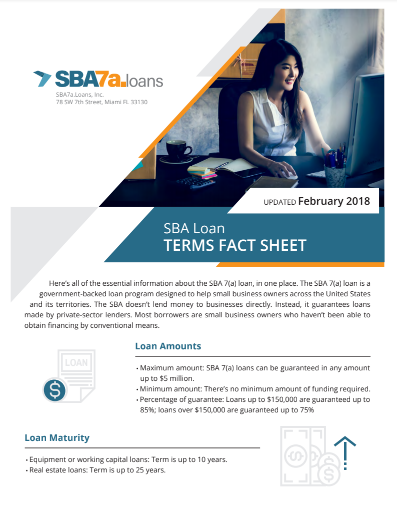
If you're wondering about collateral, loan length, terms, and rates (but don't want to sift through pages of literature) you've come to the right place. Here's our free SBA 7(a) loan fact sheet. Use this one-pager as your quick reference guide to the Standard 7(a) loan. Inside, you'll find key details about what you can use the SBA 7(a) loan for, maximum and minimum amounts, eligibility and credit requirements, and information about collateral and down payments.
Put it on your office wall, share it with a friend, print it off and use it to play paper football -- the choice is yours! Happy small business-ing.
Download the SBA 7(a) Fact Sheet
To learn more about the SBA 7(a) loan program or to get a free quote, simply click the button below to connect with an sba loan specialist!
Related questions
What is the maximum loan amount available through the SBA 7(a) program?
The maximum loan amount available through the SBA 7(a) program is $5 million, as stated on this page.
What are the eligibility requirements for the SBA 7(a) loan program?
The SBA 7(a) loan program has the following eligibility requirements:
- The business must meet the SBA's size standards for its particular industry.
- The business must have fewer than 500 employees and less than $7.5 million in revenue each year for the previous three years.
- The business must physically be based in the U.S. and operate within the U.S. and its territories.
- The business must operate for profit.
- Business owners must first have used other sources of financing, including personal funds, in order to qualify.
- Businesses must not be involved in lending, real estate, or speculation.
- Your business must operate for profit. Nonprofits and not-for-profit businesses are not eligible.
- You must also have some equity in the business, this could mean you already have a profitable business, or you could use your own personal equity as collateral.
- If you have any alternative financial resources, you must have used them first. For example, if you have a personal savings account or are able to get a personal loan, then you must first pursue those options before applying for an SBA 7(a) loan.
- The business owner cannot be on parole.
- You must be doing business in the U.S. or its territories.
What types of businesses are eligible for the SBA 7(a) loan program?
The SBA 7(a) loan program is available to businesses with fewer than 500 employees. Eligible businesses include those in the business services and office-based companies sector, such as those that need funding for day-to-day operational costs, expansion, inventory needs, and even refinancing debt. The SBA also focuses on boosting female business owners.
Eligible business types for SBA 7(a) loans include:
- Retail
- Manufacturing
- Wholesale
- Service
- Restaurants
- Franchises
- Agriculture
- Non-profits
- Real estate
- Construction
- Transportation
- Hotels and motels
- And more
If your current industry isn’t kicked out of the running due to the ineligible small businesses list, you’ve still got a shot at an SBA 7(a) loan. To get started, you can get a free SBA 7(a) loan quote from SBA7a.loans.
What are the typical interest rates for SBA 7(a) loans?
SBA 7(a) rates are capped, not set, and loan term no longer changes the ceiling. The maximum is the base rate, usually WSJ Prime, plus 6.5 percentage points at $50,000 and under, plus 6.0 points from $50,001 to $250,000, plus 4.5 points from $250,001 to $350,000, and plus 3.0 points above $350,000. The split that priced loans differently under and over seven years was repealed in 2022. Fixed-rate loans use their own breakpoints. Ceilings confirmed against 13 CFR 120.214(d) on July 30, 2026.
Source: www.sbaexpress.loans/blog/sba-express-loan-interest-rates
What are the repayment terms for SBA 7(a) loans?
The repayment terms for SBA 7(a) loans vary depending on the type of loan. For commercial real estate loans, the loan term is up to 25 years. For equipment loans, the loan term is up to 10 years. For working capital loans, the loan term is also up to 10 years.
You can learn more about understanding how the SBA guarantees loans here.