Key takeaways
- Commercial real estate loans are mortgages on any space that is used to generate income, including residential and industrial properties.
- To get approved for a CRE loan, you'll need a detailed business plan, financial documents, and a good credit history.
- Interest rates for CRE loans depend on the loan-to-value ratio, type of business, credit score, and financial stability.
- Fees for CRE loans include a down payment, property appraisal, survey fees, legal costs, and loan origination.
Commercial real estate lending isn’t rocket science. But the lack of resources out there on the topic certainly make it feel that way, sometimes.
That’s why we’ve designed this infographic to break it down into logical steps. It starts with what you need to get approved for a CRE loan, then describes rates and fees for commercial real estate loans, and follows up with advice about finding a commercial real estate lender and last-minute tips for making an offer. Let us know what you think in the comments!
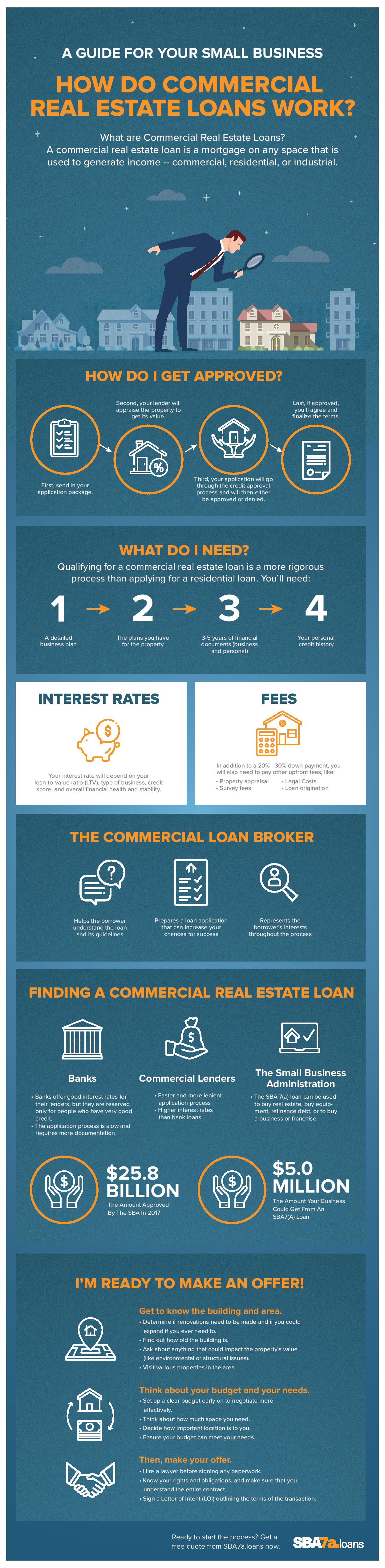
Infographic Text:
What Are Commercial Real Estate Loans?
A commercial real estate loan is a mortgage on any space that is used to generate income -- commercial, residential, or industrial.
How Do I Get Approved?
First, send in your application package.
Second, your lender will appraise the property to get its value.
Third, your application will go through the credit approval process and will then either be approved or denied.
Last, if approved, you’ll agree and finalize the terms.
What Do I Need?
Qualifying for a commercial real estate loan is a more rigorous process than applying for a residential loan.
You’ll need:
A detailed business plan
The plans you have for the property
3-5 years of financial documents (business and personal)
Your personal credit history
Interest Rates
Your interest rate will depend on your loan-to-value ratio (LTV), type of business, credit score, and overall financial health and stability.
Fees
In addition to a 20% - 30% down payment, you will also need to pay other upfront fees, like:
Property appraisal
Survey fees
Legal Costs
Loan origination
The Commercial Loan Broker
Helps the borrower understand the loan and its guidelines
Prepares a loan application that can increase your chances for success
Represents the borrower’s interests throughout the process
Finding a Commercial Real Estate Loan
Banks
Banks offer good interest rates for their lenders, but they are reserved only for people who have very good credit.
The application process is slow and requires more documentation
Commercial Lenders
Faster and more lenient application process
Higher interest rates than bank loans
The Small Business Administration
- The SBA 7(a) loan can be used to buy real estate, buy equipment, refinance debt, or to buy a business or franchise.
I’m Ready to Make an Offer!
Get to know the building and area.
Determine if renovations need to be made and if you could expand if you ever need to.
Find out how old the building is.
Ask about anything that could impact the property’s value (like environmental or structural issues).
Visit various properties in the area.
Think about your budget and your needs.
Set up a clear budget early on to negotiate more effectively.
Think about how much space you need.
Decide how important location is to you.
Ensure your budget can meet your needs.
Then, make your offer.
Hire a lawyer before signing any paperwork.
Know your rights and obligations, and make sure that you understand the entire contract.
Sign a Letter of Intent (LOI) outlining the terms of the transaction.
Related questions
What are the different types of commercial real estate loans?
There are three main categories of commercial loans: bridge loans, permanent loans, and SBA loans. Bridge loans are short-term loans that are used to finance a property until a more permanent form of financing can be obtained. Permanent loans are long-term loans that are used to finance the purchase of a property. SBA loans are government-backed loans that are used to finance the purchase of a property. Additionally, there are many other types of commercial property loans, such as construction loans, mezzanine loans, and hard money loans. Each has unique upsides and downsides, and every investor should weigh all options available to make the best financing decision for their strategy.
What are the qualifications for a commercial real estate loan?
What are the benefits of a commercial real estate loan?
The benefits of a commercial real estate loan include conserving cash flow in the short term, lower monthly payments than if you were paying both principal and interest, and interest expense tax deductions. For instance, if a commercial real estate borrower pays $10,000/month in mortgage payments, $2,000 of which is interest, they would be able to take a mortgage interest tax deduction of approximately $24,000 for that year. (Source 1, Source 2)
What are the risks associated with commercial real estate loans?
The risks associated with commercial real estate loans include an increase in monthly payments at the end of the interest-only period, owing more than the property is worth if the property's value decreases, and the need for a 20-30% down payment. Additionally, the interest rate will depend on the loan-to-value ratio (LTV), type of business, credit score, and overall financial health and stability. Fees such as property appraisal, survey fees, legal costs, and loan origination may also be required. It is important to speak with a qualified commercial real estate broker to discuss all of the risks and benefits associated with this type of financing.
How long does it take to get approved for a commercial real estate loan?
In general, most commercial real estate loans, including CMBS and bank loans, will take approximately 3 months to close. While many lenders claim that they can close loans in 6 weeks or less, this is rarely the case. One major exception is hard money loans, which generally carry significantly higher interest rates (usually above 10%), and are often used for situations when a borrower has bad credit or legal issues. Hard money loans can often be funded in as little as one week.
Source: Multifamily Mortgage Calculator